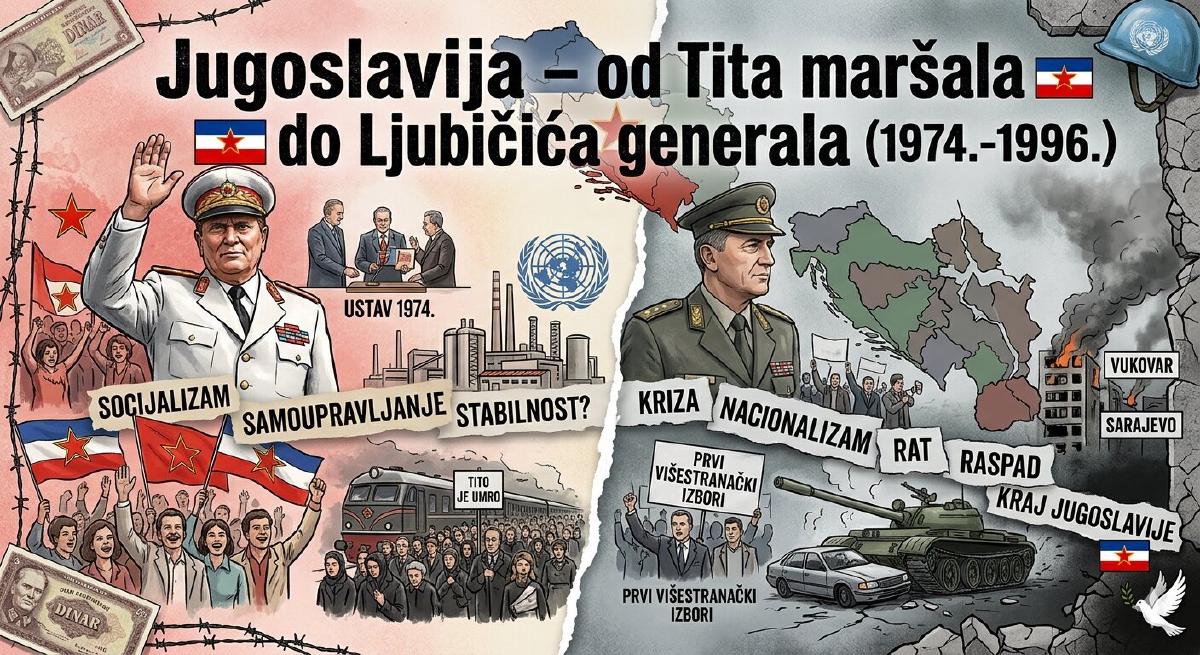
Author: Tihomir Majić
Introduction #
The final years of Tito’s rule (1974–1980) were not merely years of his physical and mental decline, but also a period of deep, almost invisible transformation of real power within the Yugoslav system.
Formally, Josip Broz Tito remained, until his death, President of the Socialist Federal Republic of Yugoslavia (SFRY), Supreme Commander of the Yugoslav People’s Army (JNA), and an unquestioned authority. Yet, in the shadow of his age and illness, a parallel structure of power increasingly took shape, whose key architect was General Nikola Ljubičić.
This essay synthesizes certain facts that have been historically documented but have not, until now, been connected with one another.
These include documented statements made by Ivo Andrić to Ljubo Jandrić on 12 and 13 June 1974; remarks by Miroslav Krleža to Branko Mikulić on 14 January 1977; the death of Džemal Bijedić four days later, on 18 January 1977; as well as Tito’s final separation from his wife Jovanka, also in 1977, together with public photographs of Tito and General Ljubičić from that period.
1. Tito in Decline: Illness and Loss of Control #
By the mid-1970s Tito was already seriously ill. His dependence on a narrow inner circle became increasingly pronounced.
In this power vacuum emerged General Nikola Ljubičić, long-serving Minister of Defence (1967–1982), who gradually took control of the key federal institution – the Yugoslav People’s Army (JNA).
It is also documented that in 1977 Tito agreed to the complete isolation of his wife, Jovanka Broz. This act, marking their final marital and personal rupture, was not merely the result of domestic disagreement but also a political decision prepared by Ljubičić, Stane Dolanc and others.
2. 1977 – Annus Horribilis of the Yugoslav Elite #
The year 1977 represents a decisive turning point. Two important events occurred:
- The isolation of Jovanka Broz (following the work of a special commission of the League of Communists of Yugoslavia – SKJ)
- The death of Yugoslav Prime Minister Džemal Bijedić in a plane crash near Sarajevo, on 18 January 1977
Although there is no conclusive evidence that Bijedić’s death was an assassination, the circumstances gave rise to serious suspicions. Bijedić was one of the few influential civilian politicians who could have represented a counterweight to the military-security lobby. His disappearance further weakened the civilian component of power.
That same year, Jovanka was removed under accusations of espionage, nationalism, and interference in personnel decisions, although the real truth may be far more shocking and still unknown to the public.
It is logical to assume that her removal was necessary in order to clear the path entirely for the military lobby – free from interference in critical relationships and channels of influence.
3. Krleža’s Testimony – The Strongest Internal Evidence #
The strongest documented indication of the real balance of power comes from Miroslav Krleža.
In a conversation he had with Branko Mikulić, Prime Minister of Yugoslavia (1986–1989), at his home in Zagreb on 14 January 1977, Krleža uttered a sentence that became historic:
“I am not sure that Tito has under control what the army leadership intends to do in a critical situation.”
This statement, recorded in Mikulić’s memoir “Fatal Years”, gains particular significance because it came from a man who had spent decades at the summit of Yugoslavia’s intellectual and political elite and who, according to Tito’s response to Mikulić, was also his landmark of sorts.
Krleža was not a conspiracy theorist but a lucid observer who perceived that real power had shifted from Tito’s office into military structures.
4. Photographs as Visual Evidence of a Shift in Power #
Alongside Krleža’s testimony, there also exists what may be interpreted as strong visual evidence.
A series of photographs from the period 1977–1979 – especially those from Brijuni, where Ljubičić appears standing above Tito while Tito sits in an armchair – represented imagery that would previously have been protocol-wise unacceptable for a subordinate general. Yet these were official photographs that passed censorship.
These photographs were not accidental. They reflected a new reality: Tito remained the symbol, while Ljubičić became the operational master of key levers of power.
5. Ljubičić’s Long-Term Scenario #
Ljubičić’s strategy was not a classic conspiracy with a fixed date for a coup, but rather a systematic, long-term preparation for the post-Tito era.
Its principal elements included:
- Taking full control of the JNA and military counterintelligence (KOS)
- Removing potential civilian rivals (Jovanka)
- Promotions and appointments within the JNA through loyalty-based personnel engineering (Mamula, Kadijević, Adžić, Gračanin…)
- Later pragmatic support for Milošević and the Serbian national movement as political fuel
This scenario proved partially successful.
In 1991, the JNA did indeed attempt to play the role of “saviour of Yugoslavia” under Serbian dominance.
Ultimately, however, the SFRY collapsed under the pressure of democratic and independence movements in Slovenia, Croatia, and Bosnia and Herzegovina, as well as international pressure.
Conclusion #
Nikola Ljubičić was not a classic conspirator; he was a pragmatic military bureaucrat who understood better than most the fundamental truth of late Yugoslavia: whoever controls the army will control whatever remains after Tito’s death.
Krleža’s intuition proved prophetic. Tito formally ruled until 1980, but real power had already shifted earlier into the hands of generals who, in the symbolic language of photography, stood above him.
And finally, Ivo Andrić – the wisest Croat and the most visionary geopolitical observer of former Yugoslavia – would, in a sense, leave a “testamentary” message to Ljubo Jandrić in Sarajevo and Mostar on 12 and 13 June 1974, as recorded in the book “With Ivo Andrić”, explaining why he never completed “Departure”, the final chapter of his most important novel, “Omer Pasha Latas”.
It will be ended by the post-Dayton “departure” of the JNA (only nominally transformed into the Army of Republika Srpska) from Sarajevo, after the bloody siege of the city from 1992–1996.
Of course, now under the command of some other Latases.
And they lied to us, how did Valter defend Sarajevo?
No, he didn’t, he occupied it!