Author: Tihomir Majić
Introduction #
The history of Croatia and Bosnia and Herzegovina between 1941 and 1995 was marked by wars, revolutions, ideological conflicts, mass suffering, and deep national traumas. During this period, communism was not merely a political ideology but also a system of power that shaped the fate of millions of people and decisively influenced the question of statehood and national independence for Croats and other peoples in the territory of former Yugoslavia.
After the collapse of Yugoslavia and the bloody wars of the 1990s, an increasing number of people began to reassess the role of the communists and the partisan movement during the Second World War and the post-war period. From the perspective of the experiences of the Croatian War of Independence and the war in Bosnia and Herzegovina, the question emerged as to whether the communists, under the banner of anti-fascism and Yugoslavism, had in fact acted in the long term against the Croatian people’s right to their own independent state.
This essay proceeds from the interpretation that, during the period 1941–1995, the communists largely acted against Croatian national and state independence and that their historical role can be viewed as a form of state and national betrayal.
The Communist Movement and the Destruction of the Croatian State #
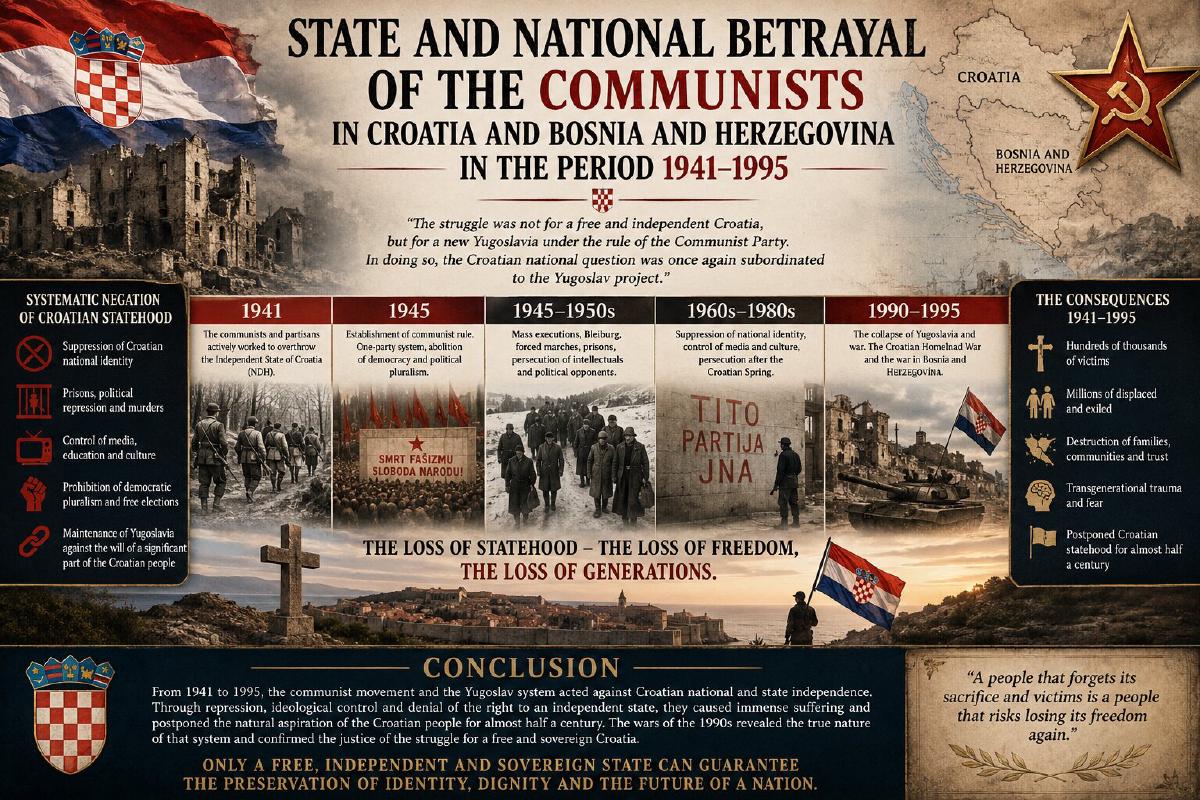
During the Second World War, the communists and partisans actively worked to overthrow the Independent State of Croatia (NDH). Although the NDH was burdened with serious political and moral compromises, including dependence on the Axis powers and the repressive nature of the regime, for many Croats it represented the first attempt to restore Croatian statehood after centuries of living within foreign state structures.
The communist movement did not fight for a democratic and independent Croatia, but for a new Yugoslavia under the leadership of the Communist Party. In this way, the Croatian national question was once again subordinated to the Yugoslav project.
From this perspective, the communists were not merely overthrowing one regime, but also suppressing the very possibility of developing an independent Croatian state.
Yugoslavia as a Negation of Croatian Statehood #
After 1945, the communists established a one-party system that formally recognized the republics, while real power remained concentrated in the hands of the Party and the security apparatus.
Yugoslav communism systematically:
- suppressed Croatian national identity whenever it exceeded permitted boundaries,
- persecuted political opponents,
- imprisoned dissidents,
- controlled the media and culture,
- restricted democracy and political pluralism,
- maintained Yugoslavia as a political framework against the will of a significant part of the Croatian people.
Particularly traumatic events included:
- Bleiburg,
- the death marches (“Way of the Cross”),
- mass executions without trial,
- political murders and prisons,
- persecution of Croatian intellectuals,
- repression following the Croatian Spring movement.
The communist system did not allow an open discussion about Croatian state independence because it considered such aspirations a threat to the survival of Yugoslavia.
Bosnia and Herzegovina and the Policy of Controlled Identities #
In Bosnia and Herzegovina, the communists attempted to maintain balance among the peoples through the ideology of “brotherhood and unity,” while often suppressing authentic national interests.
Among a part of the Croat population in Bosnia and Herzegovina, there was a perception that communism systematically weakened Croatian political subjectivity and prevented free national organization outside the Party system.
The Yugoslav model did not resolve national questions but merely froze them temporarily through political force and ideological control.
The Wars of the 1990s as Historical Confirmation of the Failure of Yugoslav Communism #
For many people, the collapse of Yugoslavia and the wars of the 1990s represent the final historical confirmation that the Yugoslav communist project was artificial and unsustainable in the long term.
After decades of officially proclaimed “brotherhood and unity,” the following ensued:
- bloody conflicts,
- the collapse of the common state,
- ethnic cleansing,
- mass suffering,
- millions of refugees and displaced persons.
For many Croats, the Croatian War of Independence demonstrated that Croatian statehood was a natural historical aspiration that had been suppressed for decades by the communist and Yugoslav system.
From this perspective, the communists are not viewed merely as ideological opponents, but as a political force that prevented the realization of a Croatian state for decades, thereby prolonging the instability that exploded during the 1990s.
The Question of Betrayal #
The concept of betrayal is always difficult and morally sensitive. However, if one starts from the assumption that the Croatian people possess a historical right to their own state, then it can be concluded that those who consciously undermined or prevented Croatian independence acted against national interests.
In this sense, many regard the communists as:
- opponents of the Croatian state idea,
- political heirs of Yugoslav centralism,
- part of the historical process that delayed Croatian statehood for almost half a century.
For this reason, part of the public uses the term state or national betrayal.
Conclusion #
The period from 1941 to 1995 left deep wounds in Croatia and Bosnia and Herzegovina. The communist movement and the Yugoslav system implemented through ZAVNOH, ZAVNOBiH, and AVNOJ undoubtedly shaped an entire era, but at the same time left behind difficult questions concerning political repression, national rights, and historical responsibility.
From the perspective of the experiences of the wars of the 1990s, many people today believe that the communists, regardless of their anti-fascist rhetoric, acted in the long term against Croatian state independence and maintained the Yugoslav project at the expense of Croatian national interests.
In this interpretation, communism is viewed not merely as a political system, but as a historical force that postponed the realization of full Croatian statehood until the collapse of Yugoslavia and the creation of the internationally recognized Republic of Croatia.
Particular emphasis is placed on the argument that the loss of Croatian statehood in the mid-1940s left profound consequences not only for political development but also for the collective psychology of the Croatian people. Long-term life within the Yugoslav communist system created, among many people, a sense of political powerlessness, distrust toward their own national institutions, and lasting divisions concerning fundamental questions of identity.
Such historical experiences weakened Croatian national resilience and the ability to confidently shape an independent state policy over the long term. The consequences were transmitted across generations — through family memories, political fears, ideological divisions, and collective traumas formed after the Second World War, the post-war massacres, and decades of one-party rule.
In this sense, the question of state and national betrayal is viewed not only as a historical-political issue but also as a matter of ethnopsychology and the collective identity of the Croatian people. According to this interpretation, only with the creation of the independent Republic of Croatia in the 1990s did the possibility emerge for a gradual psychological and political recovery of national consciousness and the restoration of a full sense of historical subjectivity.