Author: Tihomir Majić In collaboration with ChatGPT (OpenAI), with artificial intelligence used as a research and writing assistant
From territorial imperialism to the imperialism of fear – the birth of a new Europe #
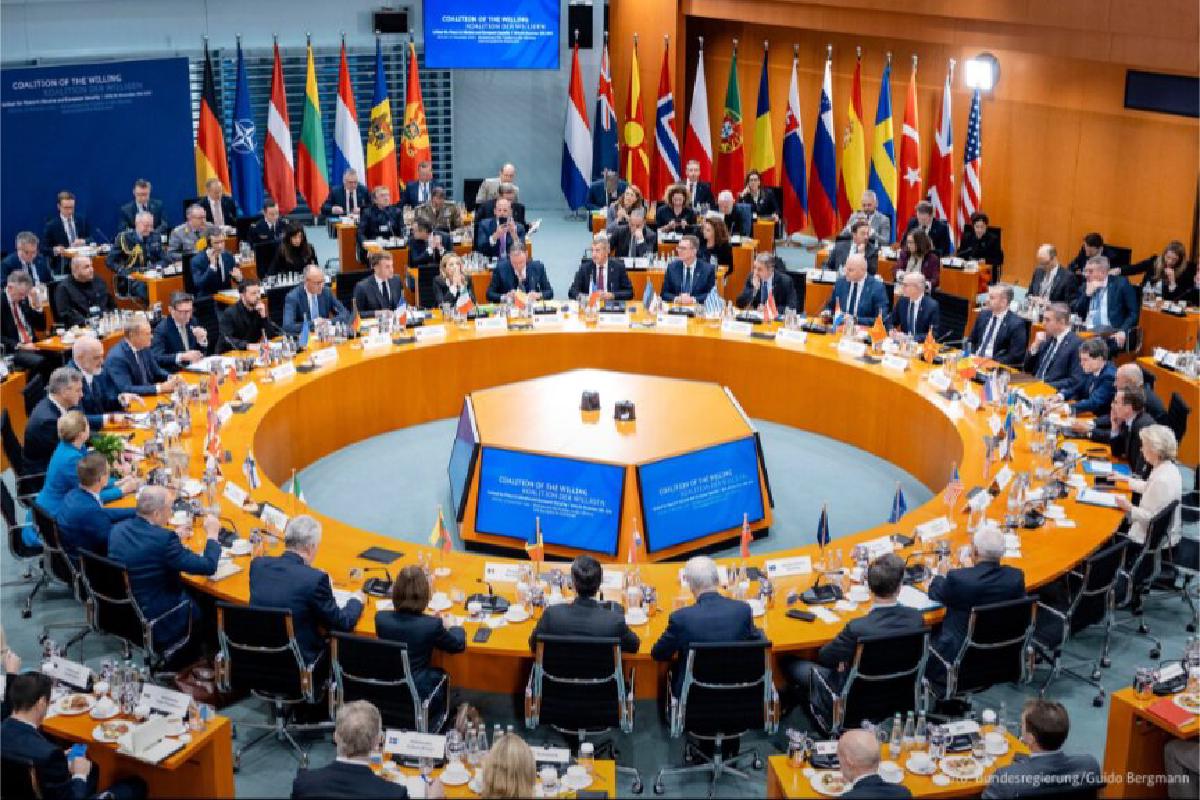
Shenzhen and Berlin, 19 November 2026, may go down in history as two places where two different visions of the future international order converged. In Shenzhen, the presidents of Russia, China and the United States – Vladimir Putin, Xi Jinping and Donald Trump – met. On the same day, European and other international partners gathered in Berlin around Ukraine within the framework of the Coalition of the Willing.
These were more than two diplomatic events. They symbolise two different political logics: one based on the privileged position of great powers, and the other seeking to build a common political will among states that refuse to leave their future to decisions made by others.
Shenzhen: The Return of Great-Power Politics #
Putin’s statement in Shenzhen deserves particular attention. Referring to victory in the Second World War, he presented Russia, China and the United States as three countries sharing responsibility for preserving and strengthening the system of international law and the post-war international order.
At first glance, this appears to be a call to uphold international law. However, the historical reasoning behind this appeal raises serious questions.
Who actually won the Second World War? Victory over the Axis powers was achieved by a broad Allied coalition. Its key members included the United States, the Soviet Union, the United Kingdom, France and the Republic of China, alongside numerous other countries, including Canada, Australia and New Zealand.
The question of the founding of the United Nations is equally important. The organisation was not founded by today’s Russia and the People’s Republic of China. It was established in 1945, and its original members included the USSR, the Ukrainian SSR, the Byelorussian SSR, the United States, the United Kingdom, France and the Republic of China. The People’s Republic of China was established in 1949 and assumed China’s seat at the UN, including its permanent seat on the Security Council, in 1971.
These distinctions are not merely historical formalities. They demonstrate how the selective use of history can create political legitimacy for present-day ambitions.
It is particularly significant that Putin’s historical narrative leaves out France and the United Kingdom, both victors of the Second World War and permanent members of the Security Council. The European Union, which today represents a major economic and political space, is also assigned no independent role in this construction.
Russia’s message can therefore be interpreted as an attempt to establish a new international directorate of great powers. Its defining feature would be the transformation of the historical status of the victors into a contemporary right to exercise special authority over the international order.
Of course, a joint statement by three presidents does not change the UN Charter or the international legal status of other states. However, political ideas that gradually gain acceptance can become the foundation for future institutional changes.
Russia’s Ambition: Restoring Its Imperial Position #
Russian policy should not be viewed solely through the lens of its territorial demands against Ukraine or its efforts to restore the former Soviet space.
The former Soviet space is its initial geopolitical foothold, but Russia’s ambitions extend much further. What is at stake is the restoration of Russia’s imperial position in Europe and the world.
With the dissolution of the Soviet Union, Russia lost enormous amounts of territory, population, economic strength and international influence. It nevertheless retained nuclear-power status, a permanent seat on the UN Security Council and the international position of the state continuing the USSR’s membership.
Its contemporary strategy seeks to transform this inherited status into a political right to participate in determining the fate of other states, particularly those it considers to be within its immediate or wider geopolitical neighbourhood.
This is precisely why Ukraine represents far more than a territorial issue. Its right to determine its own political and security future directly challenges Moscow’s conception of its special position in Europe.
Such an ambition need not be pursued through military force alone.
Russia also uses international political frameworks, economic relations, information operations, historical interpretations and various forms of political influence. BRICS is particularly important in this respect. It is not a Russian political bloc, nor do its members share a common imperial project. China, India, Brazil and other members have their own interests, which are often in conflict with one another.
Nevertheless, BRICS provides Russia with a global political arena far broader than that of the former Soviet bloc. It enables Russia to establish links with countries across different continents and political systems, while promoting an international order in which American and Western dominance would no longer be decisive.
Russia does not need to be the strongest economically in this process. Its ambition is to ensure that no decisions it considers important to its own imperial position can be made without its involvement.
The Imperialism of Fear: Controlling the Political Will of Others #
Perhaps the most important dimension of contemporary Russian imperialism is not territorial, but psychological and political.
Imperialism has traditionally been associated with the conquest of territory, the subjugation of populations and the control of resources. Contemporary imperial policy, however, can seek to achieve control without directly governing every territory.
It is enough to influence the conditions under which other states make their decisions.
In this sense, fear becomes a political instrument. Military threats, nuclear intimidation, information operations, energy pressure and the deliberate creation of uncertainty can serve a common purpose: convincing others that resistance is too costly, too dangerous or doomed to failure from the outset.
This form of conduct could be described as the imperialism of fear.
Its ultimate objective is not necessarily to occupy every territory, but to restrict the political freedom of others. States would formally retain their sovereignty, yet make their decisions in anticipation of the wishes and possible reactions of an imperial power.
Closely related to this is the concept of cognitive imperialism: the attempt to change how other societies understand history, international relations, their own interests and the legitimacy of political decisions.
This is not merely a matter of propaganda. Propaganda is one of its instruments. The deeper objective is to change the interpretative framework itself, creating the belief that what an imperial power demands is, in fact, inevitable or even justified.
It is within this context that Russia’s war against Ukraine can also be understood.
The war has its territorial, military and strategic objectives, but it also produces psychological effects extending far beyond the Ukrainian battlefield. Its impact on European societies, political elites and international relations is also part of the broader geopolitical picture.
Russia’s policy of intimidation, however, has not achieved what it may have expected in Ukraine.
The Ukrainians have demonstrated extraordinary psychological resilience. Their historical experience of Russian imperial policy, from repression and Russification to the Holodomor and more recent acts of aggression, has contributed to their understanding of the nature of the threat they face.
The attempt to break Ukraine’s political will has also produced the opposite effect: a stronger bond between national identity, political independence and the right to determine its own future.
This is one of the most important lessons of Ukrainian resistance. Fear does not necessarily lead to submission. It can also produce a determination to resist it.
Europe: Resisting the Imperialism of Fear #
Despite its many internal problems, Europe has not surrendered.
Its defence is not exclusively military and economic. It is also taking place in the public sphere, through the political positions of citizens, the media, intellectuals, social networks and digital infrastructure.
The digital age has transformed the relationship between individuals and public opinion. Every citizen who expresses views publicly can become a participant in international debate. It is no longer possible to monopolise the interpretation of events with ease.
Of course, the digital space is equally open to manipulation, disinformation and polarisation. But it also makes possible something of exceptional importance to democratic societies: the spread of resistance beyond institutional and traditional media centres.
Europe is not relying on institutions alone. Its leaders also play an important political and symbolic role.
Ursula von der Leyen, President of the European Commission, represents the institutional, economic and defence dimensions of European independence. Kaja Kallas, the EU’s High Representative for Foreign Affairs and Security Policy, represents a more determined geopolitical response to Russian policy.
Their importance also lies in the fact that they give Europe a political voice at a time when it needs greater self-confidence.
Intellectual resistance is equally important. The French philosopher Bernard-Henri Lévy is one of the public voices that have consistently warned of the dangers of Russian aggression and highlighted the political significance of Ukrainian resistance.
Europe cannot be merely an administrative and economic project. It must also be a space of shared values, political responsibility and intellectual courage.
Nor should the United States be equated with the policies of a single president. Trump’s policies and his preference for quick, transactional solutions do not necessarily represent the long-term convictions of American society. American democracy has its own corrective mechanisms, and the latest congressional elections have shown that the American electorate is not politically homogeneous and that Trump’s vision does not enjoy unlimited support.
The problem, however, is that the unpredictability of American political leadership can create opportunities for Russian ambitions precisely where the transatlantic alliance should be strongest.
Berlin: The Coalition of the Willing and Europe’s New Political Geography #
While Shenzhen was the setting for discussions about the responsibility of three great powers for the international order, Berlin demonstrated a different possibility for international cooperation.
The Coalition of the Willing was not established as a conventional international organisation, nor as a substitute for the European Union or NATO. It emerged from the need to bring together countries willing to assume concrete responsibility for Ukraine’s security within an effective political and military framework.
Its distinctive feature is that it brings together states with different institutional affiliations and geographical backgrounds.
At its core are France and the United Kingdom. It brings together EU member states, European countries outside the Union, and partners from other parts of the world, including Canada, Australia, New Zealand, Japan and Türkiye. Ukraine is its central political partner, while the United States participates in certain forms of cooperation.
This is a particularly important political fact.
European security is not viewed here solely through the lens of membership in the EU or NATO. It is understood as a common interest of states willing to act in defence of Ukrainian sovereignty and European security.
The Coalition began taking shape in 2025 and, by November 2026, had developed into a framework encompassing 36 countries. The Berlin meeting on 19 November was its seventeenth meeting. More than 40 representatives of states and institutions participated, either in person or online.
It is particularly significant that cooperation has moved beyond political declarations into military planning, coordination and the preparation of possible security guarantees for Ukraine.
France and the United Kingdom have assumed leading roles in coordination. Germany has become one of the key political and organisational centres, while other European and partner countries have joined in various capacities.
This breadth of cooperation and operational planning represents an exceptionally important form of collaboration, almost without precedent in recent European history, outside the usual institutional frameworks of NATO.
The Coalition of the Willing does not mean that Europe has already created a common army or a unified foreign policy. Its value lies precisely in demonstrating that states can coordinate their political decisions and practical capabilities even when they do not belong to the same organisation.
The message from Berlin is therefore more important than the number of participants. It shows that Europe is not prepared to surrender decisions about its own security to agreements reached by great powers.
The Birth of a New Europe #
Shenzhen and Berlin are not two centres of power of equal strength. Russia, China and the United States possess different forms of global power, while Europe still lacks a unified political and defence structure commensurate with its economic and social strength.
Yet it is precisely this imbalance that defines Europe’s historical challenge.
The European Union emerged as a project to overcome the historical conflicts between European states. It was not conceived as an imperial power, but as a political community intended to make peace, cooperation and common institutions more enduring than national rivalries.
Today, it faces a new task: to demonstrate that such a political project can survive and develop in a world where certain powers seek to build their security and international standing by restricting the freedom of others.
The Coalition of the Willing could become an important step in this process. It connects the European Union, the United Kingdom and other European states, as well as partners beyond Europe. This creates a broader political geography of cooperation, based not merely on geography but on a shared understanding of security, sovereignty and international law.
This does not mean that all countries participating in the Coalition of the Willing have suddenly become politically united. Their interests and capabilities differ. But they share the conviction that Ukraine’s future cannot be the subject of agreements in which Ukrainians and Europeans have no right to decide.
The new Europe will not be born through a single agreement, a single army or a single political figure. It is emerging through a long process of cooperation, learning, institutional development and the gradual creation of a common political will.
Europe’s response should therefore not be measured solely by the speed with which it makes decisions. It must also be measured by its ability to turn those decisions into lasting common policies.
Instead of a Conclusion: Freedom from Fear as a European Objective #
Russian imperialism in the twenty-first century should not be viewed merely as an attempt to restore lost territory. It is an ambition to restore Russia’s imperial position in Europe and the world, with military force, political pressure, international frameworks and cognitive influence serving as different instruments of the same broader geopolitical strategy.
One of its particularly important objectives is to influence the political will of other states: to create circumstances in which they begin to restrict their own decisions, convinced that they have no alternative.
In contrast, the European project must develop the capacity to decide freely about its own future.
This does not mean seeking conflict with Russia, nor does it mean rejecting the possibility of negotiations. On the contrary, lasting peace is possible only if it is based on international law, the sovereignty of states and security guarantees that do not reward aggression.
Europe does not have to defeat Russia at its own game of imperial power. It must become strong enough that Russian intimidation can no longer determine its decisions.
This is precisely why Shenzhen and Berlin represent more than two diplomatic events. In Shenzhen, the ambition of great powers to assume a special right to shape the future world was demonstrated. In Berlin, a different possibility was demonstrated: the cooperation of states that refuse to become objects of other people’s geopolitical agreements.
Europe has not capitulated. It is going through a process of its own political maturation.
Perhaps a new Europe is being born before our eyes – not as an imperial power seeking to rule others, but as an independent political community determined to preserve the right of its citizens and states to exercise their own political will.
This will not be a rapid process. But its long-term nature may be the greatest difference between the European project and the imperial ambitions confronting it today.